
THE APPLES
Twenty-three varieties, and counting
The orchard was planted in the 1970s with the standard New York varieties of the era: Empire, Rome and Red Delicious. We are topworking many of those trees over to varieties chosen for flavor, texture and season, and planting new ones alongside them.
We select apples for their unique characteristics, including flavor and appearance, as well as for their usage, including cider and dessert.


THE SEASON
When each variety comes ready, from late summer into December
- Pink Pearl
- White Cloud
- Egremont Russet
- Empire
- Manchurian Crab
- Robert’s Crab
- Belle de Boskoop
- Golden Russet
- Herefordshire Redstreak
- Kandil Sinap
- Kingston Black
- Rome
- White Winter Pearmain
- Yarlington Mill
- Arkansas Black
- Black and Red
- Dabinett
- Hella Kitty
- Stoke Red
- Vanilla Pink
Denniston Red · Kaz-C · Kaz-J
THE WILD APPLE
Malus sieversii, from the Tian Shan of Kazakhstan
Every apple in the orchard descends from a wild fruit forest in the Tian Shan mountains of Central Asia. In the 1920s the Russian botanist Nikolai Vavilov identified the region as the apple’s center of origin, and genetic work since has confirmed Malus sieversii as the primary ancestor of the domestic apple, later crossed with the European crabapple as fruit traveled west along the Silk Road.
In the 1990s, USDA scientists at Cornell’s Geneva campus led expeditions to Kazakhstan and Kyrgyzstan, returning with 949 collections of seed and budwood that roughly doubled the known genetic diversity of apples. Kaz-C and Kaz-J are two selections of that wild apple, now growing here beside their descendants.
Kaz-C
- Species
- Malus sieversii
- Origin
- Kazakhstan, wild
- Here since
- [2026]
- Fruit
- To be recorded
Kaz-J
- Species
- Malus sieversii
- Origin
- Kazakhstan, wild
- Here since
- [2026]
- Fruit
- To be recorded

RENOVATING THE ORCHARD
How an orchard from the 1970s becomes an uncommon one
Cover Crops
In spring 2026 we sowed the ground in clover and field pea. Both are legumes, fixing nitrogen from the air into the soil, while their roots build organic matter and structure. The clover in bloom also feeds the bees.
Restoration Pruning
Old, overgrown trees are opened to light and air over several winters. Dead and crossing wood comes out and height comes down, bringing each tree back into balance and production.
Topworking
Selected trees are grafted over to new varieties, including scion wood from Steve Edholm of SkillCult. A mature root system carries the new wood, so a topworked tree bears years sooner than one planted new.
New Plantings
In spring 2027, new trees go in alongside the old orchard [on rootstocks chosen for our site], into ground the cover crop has spent a year preparing.
TOPWORKING
May 2026 - A New Era
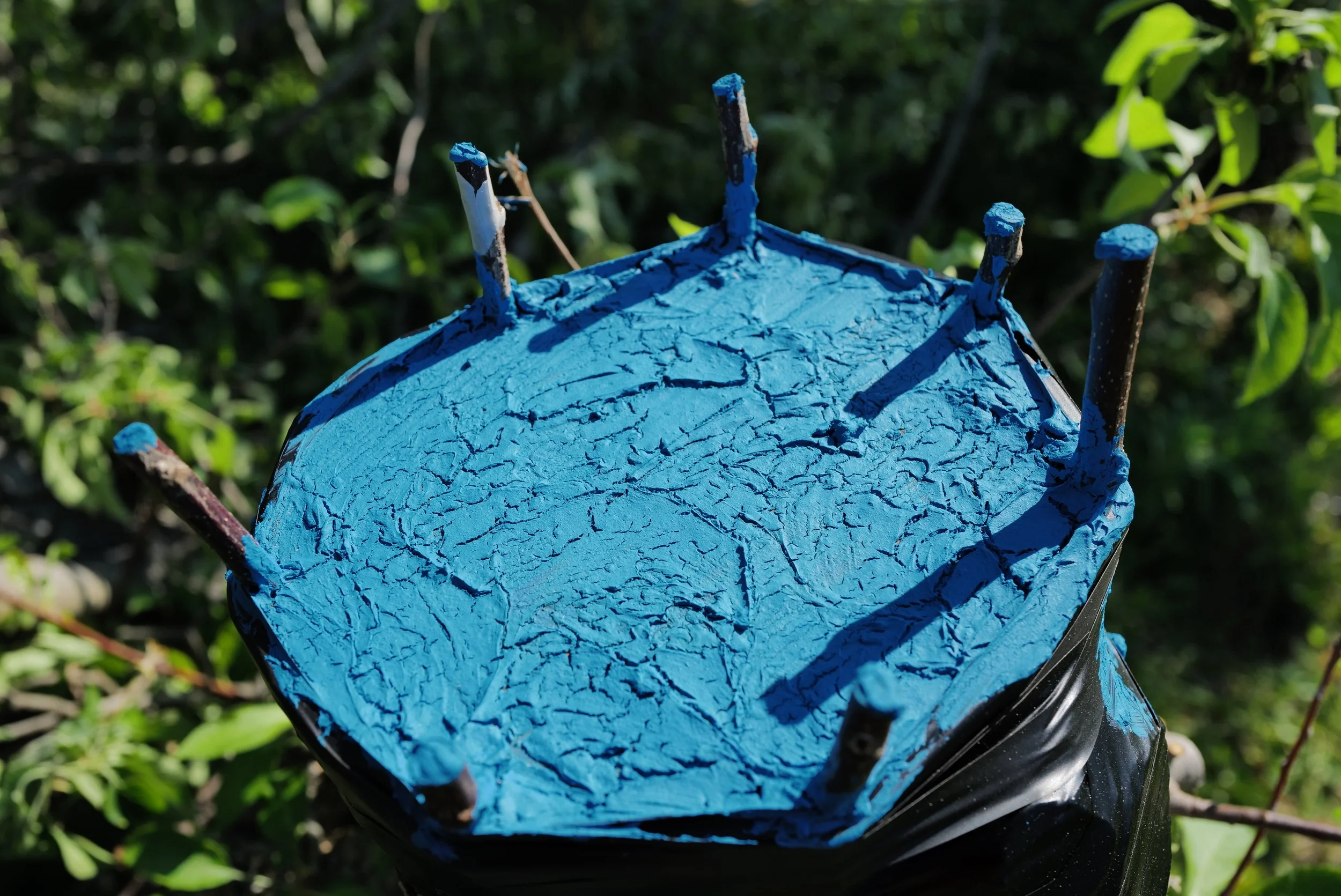
Bark graft: Kingston Black scions around a headed-back Empire scaffold, spring 2026
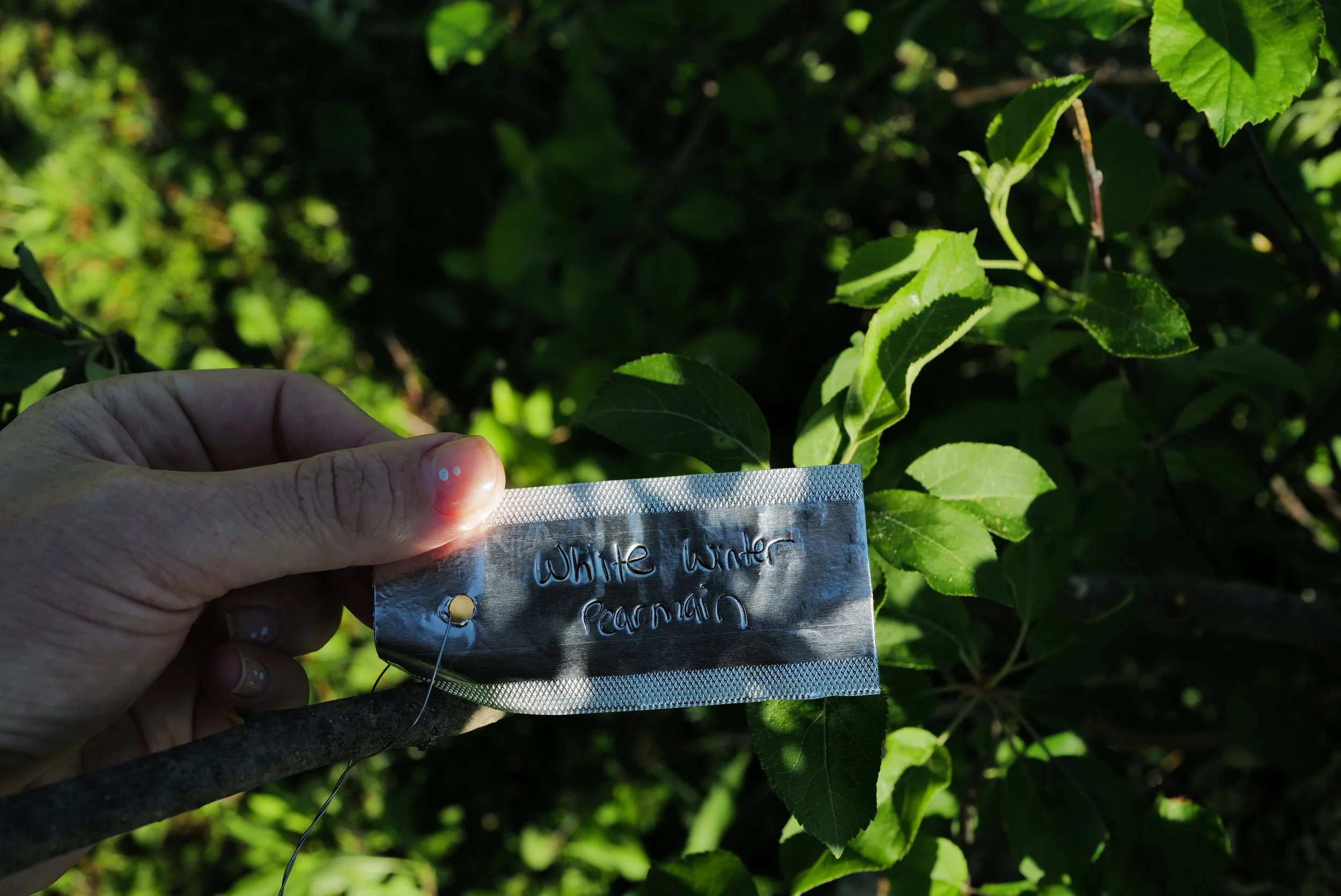
Each graft tagged by variety: White Winter Pearmain
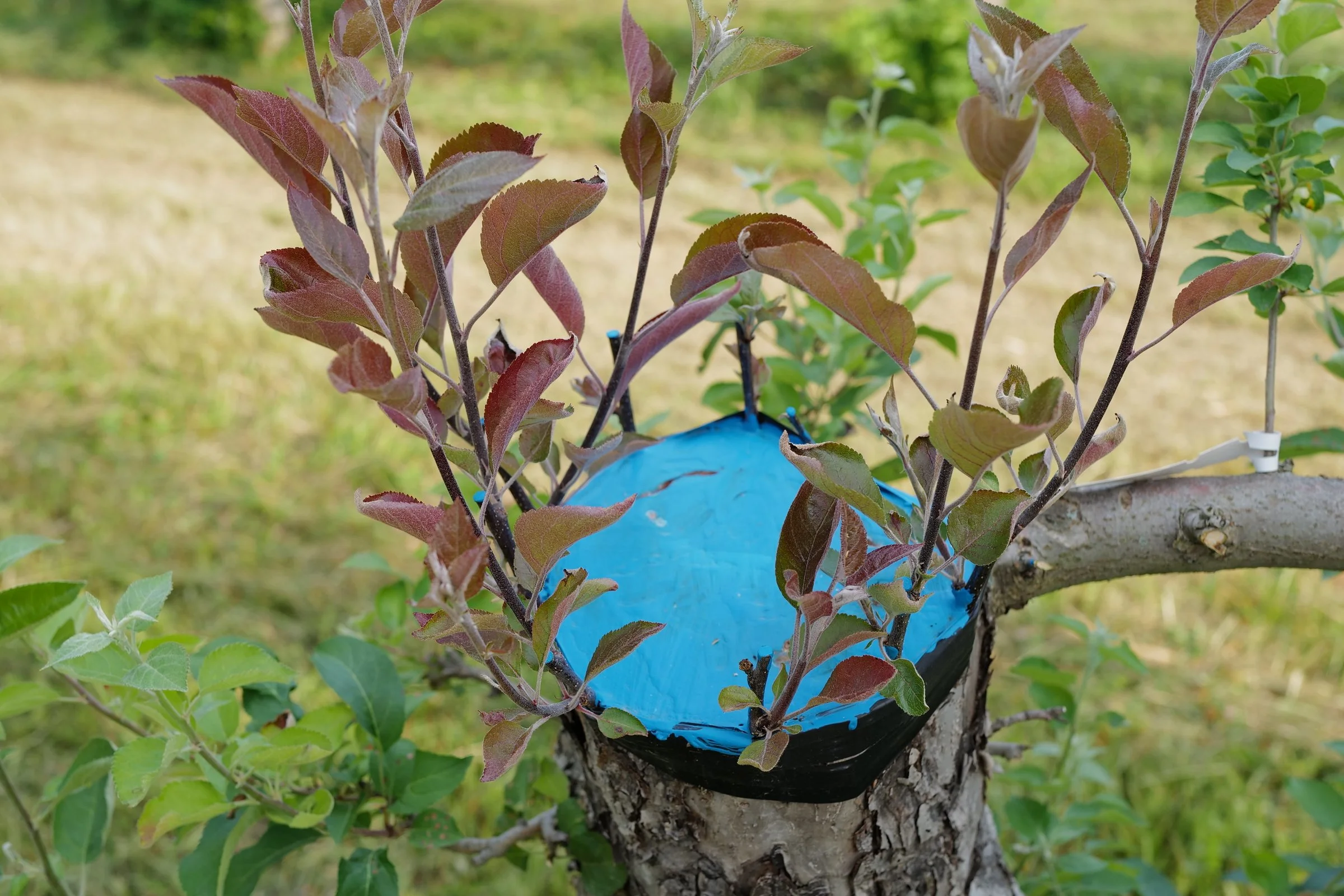
First-season growth from the new grafts, summer 2026
THE COLLECTION
Every variety in the orchard
The Kazakh selections. Kaz-C and Kaz-J are Malus sieversii, the wild apple of the Tian Shan mountains of Kazakhstan and the primary ancestor of the domestic apple. In the 1990s, USDA scientists at Cornell’s Geneva campus led expeditions to Kazakhstan and Kyrgyzstan, bringing back seed and budwood that roughly doubled the known genetic diversity of apples.
The SkillCult seedlings. Black and Red, Hella Kitty and Vanilla Pink come from Steve Edholm’s red-fleshed apple breeding project at SkillCult, which crosses intensely colored apples with fine dessert varieties.